Limit what a location can hold
What this does
A storage category puts a ceiling on a location — so many pallets, so many units, so many kilos — and putaway then routes goods to a location that still has room.
Before you start
- Enable Storage Locations and Multi-Step Routes; add Packages too if you want limits per package type.
- Set up a parent location with sub-locations. The putaway rule points at the parent; the categories sit on the children.
Steps
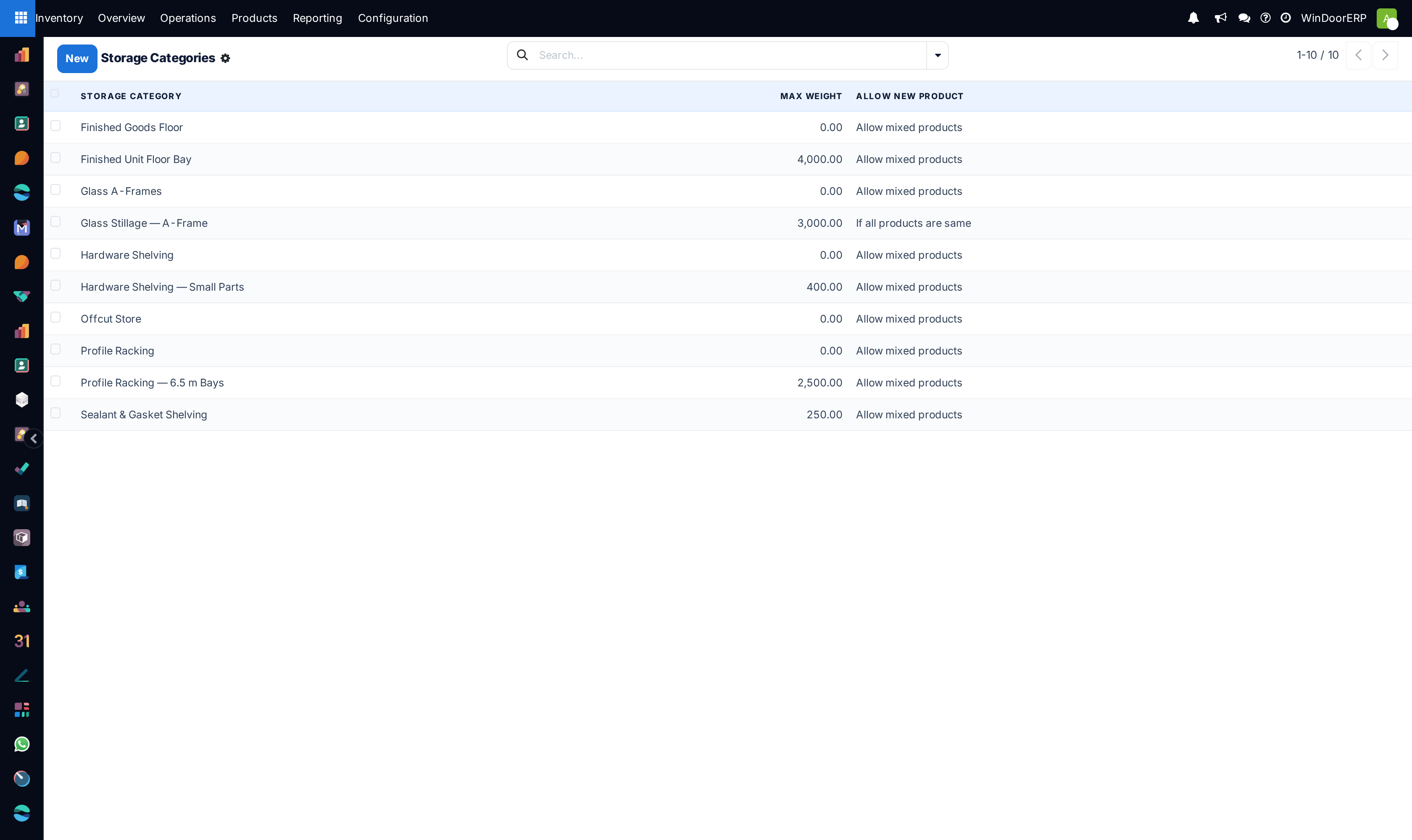
A storage category is used with putaway rules to assign a storage location to incoming products while accounting for the capacity of that location. Assigning categories to storage locations tells WindoorERP these locations meet specific requirements, such as temperature or accessibility. WindoorERP then evaluates these locations, based on defined capacity, and recommends the best one on the warehouse transfer form.
Follow these steps to complete the setup:
- Enable features in the settings
- Define capacity limitations
- Assign a category to storage locations
- Add the storage category as an attribute to a putaway rule
-
01
Go to Inventory › Configuration › Storage Categories and click New.
-
02
Name it after the constraint, not the contents — Two pallets max, Heavy rack.
-
03
Set Max Weight, and add lines under Capacity by Product or Capacity by Package.
-
04
Choose Allow New Product: only if the location is empty, only if the same product is already there, or mixed products allowed.
-
05
Save.
-
06
Open each sub-location under Configuration › Locations and set its Storage Category.
-
07
On the putaway rule, set Sublocation to Closest Location and pick the category in Having Category.
Enable storage categories
To enable storage categories, go to Inventory app › Configuration › Settings. Then, in the Warehouse section, ensure the Storage Locations and Multi-Step Routes features are enabled.
To set capacities by package type, also make sure Packages is enabled in the Operations section. Click Save.
Storage location setup
Set up storage locations to work with the storage category. A parent location must be set up, with child locations (or sublocations) assigned to it. This is because the putaway rule's Store to location will be set to the parent location, and the storage category will be set to the child location.
Go to Inventory app › Configuration › Locations.
First, set up a parent location. This can be as simple as the default WH/Stock location. Alternatively, create a new parent location by clicking the New button on the Locations page. On this parent location form, specify a Location Name and Parent Location. Select Internal as the Location Type.
Then, create sublocations of this parent location by clicking the New button. On the location form, specify a Location Name, and set the Parent Location to the parent location that was just created.
Example
A beverage company stores all of its cans of lemonade on pallets in one section of its warehouse.
First, they create a location named Pallets in the WH/Stock location. Then, they create two sublocations, named PAL1 and PAL2. Both have WH/Stock/Pallets set as the parent location.
Define storage category limitations
Before a storage category is applied to locations, it must be configured with specific limitations in order to decide the optimal storage location. Capacity can be limited by weight, product, and package type.
To create a storage category, go to Inventory app › Configuration › Storage Categories, and click New.
On the storage category form, type a name for the category in the Storage Category field.
Note
Weight limits can be combined with capacity by package or product (e.g. a maximum of one hundred products with a total weight of two hundred kilograms).
While it is possible to limit capacity by product and package type at the same location, it may be more practical to store items in different amounts across various locations, as shown in the limit capacity by package example.
The Allow New Product field defines when the location is considered available to store a product:
- If location is empty: a product can be added there only if the location is empty.
- If products are the same: a product can be added there only if the same product is already there.
- Allow mixed products: several different products can be stored in this location at the same time.
Important
WindoorERP does not automatically split quantities across multiple storage locations. If an incoming receipt contains several units or packages and the first recommended location exceeds its capacity, WindoorERP still routes all items to that same location instead of selecting another one with available space.
(Example: If a location can hold 10 units and 12 units arrive, all 12 are still assigned to that location.)
Limit capacity by weight
A maximum product weight can be set in the Max Weight field. This limit applies to each location assigned this storage category. If a product weight is defined, the value must be set to greater than 0.
Limit capacity by product
In the Capacity by Product tab, click Add a Line to enter a product, and set the maximum capacity that should be stored at each location in the Quantity field.
Example
To ensure only a maximum of five Large Cabinets and two Corner Desk Right Sit are stored at a single storage location, specify those amounts in the Capacity by Product tab.
Limit capacity by package type
Limiting capacity by package makes it possible to enforce real-time storage capacity checks based on package type (e.g., crates, bins, boxes, etc.).
Click Add a line to add a package type to the storage category. Alternatively, create a new package type on the Inventory tab of the product form (in the Packaging section), or from the Product Packagings page.
Example
To help create putaway rules for pallet-stored items, create the High frequency pallets storage category.
In the Capacity by Package tab, specify the number of packages for the designated Package Type, and set a maximum of 2.00 Pallets for a specific location.
Important
WindoorERP does not automatically split quantities across multiple storage locations. If an incoming receipt contains several units or packages and the first recommended location exceeds its capacity, WindoorERP still routes all items to that same location instead of selecting another one with available space.
(Example: If a location can hold 10 units and 12 units arrive, all 12 are still assigned to that location.)
Assign storage locations
After the storage category is created, it can be assigned to the sublocations. Go to Inventory app › Configuration › Locations, and open the desired sublocation. Then, select the created category in the Storage Category field.
Example
Assign the High frequency pallets storage category (which limits pallets stored at any location to two pallets) to the WH/Stock/Pallets/PAL1 sublocation.
Repeat this step for all sublocations to which the storage category should apply.
Tip
On the storage category form, the Locations smart button shows which storage locations the category has been assigned to.
Create a putaway rule
With the storage category and locations set up, create the putaway rule by navigating to Inventory app › Configuration › Putaway Rules.
Click the New button to create the putaway rule. Specify a location in the Store to field.
Use the Sublocation field to specify that you want to use a storage category on the sublocations of the Store to field:
- Last Used: The last location that had a move associated with it for that product or product category is used. If there is no last location used, the destination is whatever is specified in the Store to field.
- Closest Location: The locations specified as part of the storage category are used. A storage category is mandatory in the Having Category field. The locations in the storage category must be sublocations of the location in the Store to field. If the closest locations in the storage category are full, the Store to location is used.
Example
Continuing the example from above, the High frequency pallets storage category is assigned to the putaway rule directing pallets of lemonade to locations with the High frequency pallets storage category assigned to them.
Note
If products are not routing to secondary locations for a storage category and a product weight is defined, verify that the storage category's Max Weight value is set to a number greater than 0.
Use case: limit capacity by package
To limit the capacity of a storage location by a specific number of packages, create a storage category with a Capacity By Package.
Continuing the examples from above, the High frequency pallets storage category is assigned to the PAL1 and PAL2 locations.
Then, putaway rules are set, so that any pallets received in the warehouse are directed to be stored in PAL1 and PAL2 locations.
Depending on the number of pallets on-hand at each of the storage locations, when two pallets of lemonade cans is received, the following scenarios happen:
- If
PAL1andPAL2are empty, the pallet is redirected toWH/Stock/Pallets/PAL1. - If
PAL1is full, the pallet is redirected toWH/Stock/Pallets/PAL2. - If
PAL1andPAL2are full, the pallet is redirected toWH/Stock/Pallets. - If
PAL1is partially full (for example, with one pallet), WindoorERP treats more than one received pallet as a single pallet on the receipt. You must manually separate the two pallets into separate storage locations. Click the Details link to the right of the Units field, and then in the Detailed Operations box, click Add a line. Finally, split the receipt by quantity into separate locations, then click Save.
Common mistakes
- Expecting a delivery to be split across two locations when the first is full. It is not: everything goes to the recommended location, over capacity and all.
- A Max Weight left at zero on a category whose products have weights — goods then never route to the secondary locations.
- Categories on the parent location instead of the children.
Was this article helpful?
Thanks — your feedback helps.
Running a window or door factory?
Ask for a demo