Check stock and its value
What this does
One line per product: how much you hold, how much of it is actually free, what is coming and going, and what it is all worth.
Before you start
- The Reporting menu in Inventory is administrator-only. If you cannot see it, that is why.
Steps
The (pencil) icon on the on-hand figure opens an inventory adjustment, so a discrepancy spotted here can be corrected here.
Use the stock report in WindoorERP Inventory for a detailed list of all stored products, including those reserved, purchased and in transit, as well as those delivered to customers.
Note
The reporting feature is only accessible to users with admin access.
To access the stock report, go to Inventory app › Reporting › Stock.
-
01
Go to Inventory › Reporting › Stock.
-
02
Narrow the view from the left sidebar — by warehouse, or by product category.
-
03
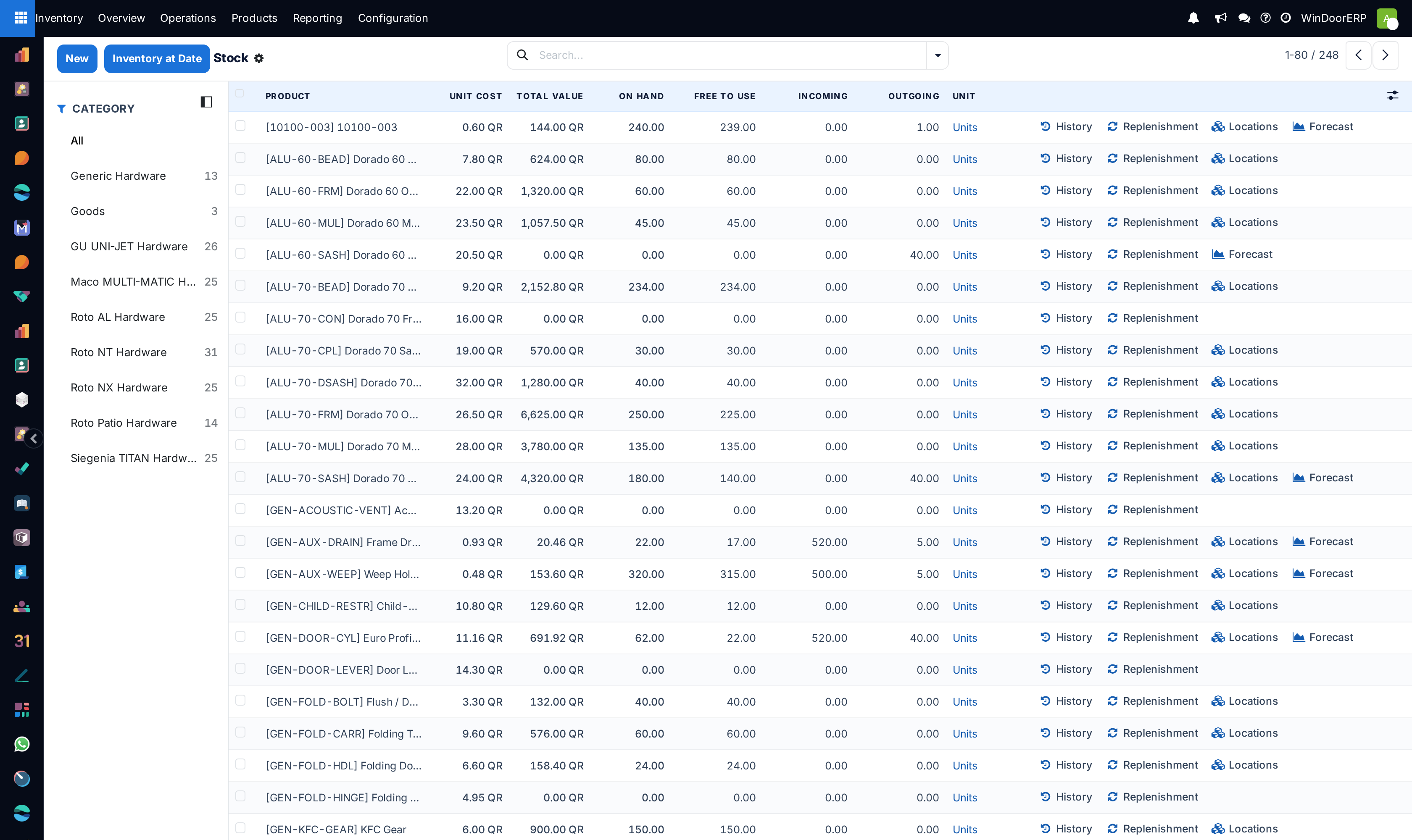
Read the columns: On Hand, Free to Use (not reserved), Incoming, Outgoing, Unit Cost and Total Value.
-
04
Use the buttons at the end of a row to jump to that product's History, Replenishment, Locations or Forecast.
-
05
Save the view you keep rebuilding with Save current search.
Navigate the report
On the stock report, the left sidebar includes several groupings to narrow down what is being shown. The default groupings are Warehouses, which filters products by specific warehouses, and Category, which shows products within a selected product category.
Note
The Warehouse grouping is only available when there are multiple warehouses in the database. Refer to the ../inventory_management/warehouses documentation for more details.
In the report itself, the columns represent:
- Product: name of the product.
- Unit Cost: average inventory valuation per unit, adjusted based on the cost to purchase and/or manufacture the product.
- Total Value: Total inventory valuation of the product, calculated by multiplying unit cost by on-hand quantity.
- On Hand: current quantity of products. Click the (pencil) icon to modify the on-hand quantity.
- Free to Use: on-hand quantity that are not reserved for delivery or manufacturing orders, and are available to sell or use.
- Incoming: items expected to arrive at the warehouse. Number of products is based on quantities in confirmed purchase orders.
- Outgoing: items expected to leave the warehouse or be consumed in manufacturing orders. Number of products is based on quantities in confirmed sales or manufacturing orders.
Click the buttons to the right of each row item to access additional information:
- History: access the stock move history of the product, displaying information about the quantity and description of why the product was moved from one location to another.
- Replenishment: access the reordering rules page for the product to create or manage methods of procuring the product.
- Locations: break down of on-hand quantity at multiple storage locations. Only available when the product is stored in multiple locations.
- Forecast: access the forecasted report to view on-hand, incoming, and outgoing quantities. Report also contains links to confirmed purchase, sales, or manufacturing orders. Only available when there are confirmed sales, purchase, or manufacturing orders for the product.
Search options
The Filters section allows users to search among pre-made and custom filters to find specific stock records.
- Published: display products published on the website. Only available with the Website app installed.
- Available in POS: display products available through the Point of Sale app.
- Available in Self: display products available in self order through the Point of Sale app. Appears in the search because the Available in Self Order checkbox was ticked in the Point of Sale section of a product form's Sales tab. The option is only available when the Available in POS checkbox is ticked.
- Not available in Self: display products available in PoS, but not available in self order.
- Can be Sold: display products that can be sold to customers. Appears in the search because the Can be Sold checkbox is ticked on the product form.
- Can be Purchased: display products that can be bought from vendors. Appears in the search because the Can be Purchased checkbox is ticked on the product form.
- Can be Recurring: show subscription products, indicated by ticking the Recurring checkbox on the product form. Only available with the Subscription app activated.
- Can be Rented: show products that can be loaned to customers for a certain time. Appears in the search because the Can be Rented checkbox was ticked on the product form. Only available with the Rental app installed.
- Can be Subcontracted: display products that can be produced by a third-party manufacturer. Available only with the Manufacturing app installed.
- Can be Expensed: show items that can be expensed. Only available with the Expenses app installed.
The Group By section allows users to add pre-made and custom groupings to the search results.
- Product Type: group items by product type.
- Product Category: group items by product category. To configure these, go to Inventory app › Configuration › Products: Product Categories.
- POS Product Category: group items by point of sale product categories.
To save the current applied filters and groupbys, so the same information can be easily accessed after closing this page, click Save current search.
Optionally, tick the Default filter checkbox to make this current view the default filter when opening the stock report. Or tick the Shared checkbox to make the search option available to other users.
Lastly, click the Save button.
Common mistakes
- Quoting the on-hand quantity to a customer when most of it is reserved for other jobs. Read Free to Use.
- Comparing total value with the accounts without knowing which valuation method the products use.
- Filtering by warehouse and forgetting it, then reporting stock that is missing only from that view.
Was this article helpful?
Thanks — your feedback helps.
Running a window or door factory?
Ask for a demo